

Featured Athlete
ASC Professional Strongman Ethan Farkas
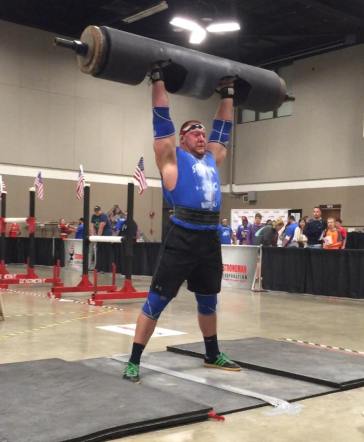
We recently got a chance to talk with American Strongman Corporation Professional Strongman Ethan Farkas. Here are his insights on what it takes to compete in a strength sport at the professional level.


When did you discover strongman and how?
Strongman was always a sport on my radar since watching the titans of World’s Strongest Man such as Mariusz Pudzianowski and Magnus Ver Magnesson. It was always a sport I was interested in, I just never felt I was strong enough to compete until several years into powerlifting. After some research, I found my first strongman show on the NAS website (Delaware’s Strongest Man, 2012) and got signed up. My passion for the sport only grew after that, and the rest is history.
Can you try to explain the sport of strongman to a casual sports fan?
It’s always a challenge to explain the sport to those unfamiliar with it. I often ask if they’ve ever seen World’s Strongest Man on ESPN or CBS sports. If the response is a no, I explain that it’s a combination of overhead lifting events, deadlifting events, as well as moving and throwing odd objects. I get some occasional baffled looks after my explanation, as if I belong in a circus. The usual follow up response is “oh, well…you should’ve played football”.
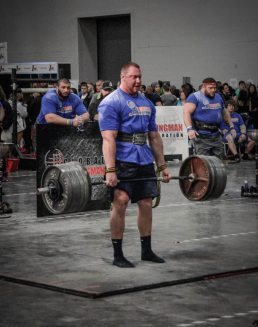
What sports did you play growing and how do you think they helped you adapt to the sport of strongman?
Through my childhood I was a multi-sport athlete. I’ve dabbled in football, lacrosse, soccer, baseball, ice hockey, track and field, wrestling and swimming. I was always active as a child yet never a stellar or passionate athlete until I was introduced to powerlifting through football. I truly believe that being a multi-sport athlete translated into strongman, allowing me to pick up new events and learn specific techniques for each one very rapidly. In addition to the adaptive capabilities I acquired through playing many sports, powerlifting paved a solid foundation of strength for me to work with as a strongman athlete.
“My goal is always to win no matter what competition I’m in”
Can you take us through a normal day in your life? From the time you wake up until you go to bed at night.
A typical training day (in a contest prep) will begin at 7 A.M. with the first meal of the day, followed by my first training session of the day which is my strength training session. Two meals later, I’ll head off to work for a few hours where I will eat another two meals before my second training session of the day. This session is high intensity-strongman type cardio training which lasts about 30-45 minutes. This session is followed by another meal, then bed time around 10 P.M.
Touching on the last question, can you give us some insight on your diet? (Nutrition, timing, calorie intake?)
My diet is always very specific to my goals and it is somewhat atypical to other strongman diets. I believe that a diet should be geared for performance and also overall health and well-being. That being said, my diet could be compared to that of a bodybuilder. Oats, eggs, chicken, beef, rice and vegetables are staples in my diet and comprise about 95% of it. I allow myself a “cheat meal” twice a week as a calorie blast to help me recover faster. My average calorie intake is approximately 5,000 calories daily during competition prep depending on my bodyweight goals. Macronutrient ratios being: 50% carb, 35% protein, 15% fats which I believe are essential to performance. In regard to nutrient timing, eating every 2-3 hours is a must for proper recovery after heavy training. Before training, I consume a light meal 45 minutes before training (including 5g creatine) followed by 12 oz black coffee. Intraworkout will be 50g of a carb shake (I prefer karbolyn) and post training will be a post-workout recovery drink such as MHP Dark Matter or Universal Torrent.
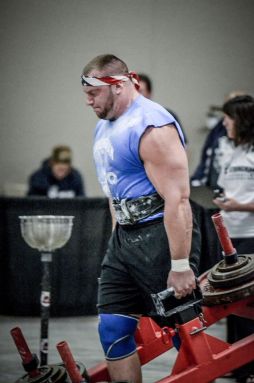
Was there on moment in your strongman career that you knew you had a chance to compete at the professional level?
Competing at the professional level was a dream of mine since the beginning, but I don’t think it really became a reality for me until my first NAS nationals in 2013 where I beat out a lot of seasoned competitors and placed 11th overall as a heavyweight and 3rd in the 300lb subdivision. At 21 years old, I knew that with some serious work and determination I could one day wear that Spartan helmet and hold a pro-card of my own like Casey Garrison did that night at Smitty’s Bar in Dennison, Texas.
What goals do you have as a professional Strongman?
This year I will be preparing for America’s Strongest Man where I will unveil the strongest, quickest and most conditioned version of myself to date. My goals for the near future are to qualify to compete at World’s Strongest Man and the Arnold Pro Strongman Classic. My goal is always to win no matter what competition I’m in or the odds against me. That’s the mentality. There’s a lot of work to be done, but I love this sport and the challenges that lay ahead.
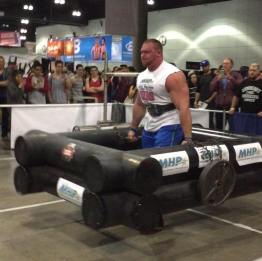
What advice would you give to any athlete who aspires to play at the collegiate or professional level?
Set realistic short and long term goals for yourself. Meet those goals and set new ones. Do everything you can to learn from successful people in your sport: what to do and what NOT to do. Make less announcements and take more actions—anyone can say “I want to play football for Penn State” or “I want to be a professional strongman”. Put those plans into action through practice, training and disciplined adherence to an effective training regimen. Last but not least, make connections with coaches, promoters and other important authoritative figures in your sport. You can be the most talented athlete in the country, but if you don’t make those connections to gain recognition your athletic career will be over before it even began.
Interview by Alex Einhorn / BE Sports Media
Be Sports Media Featured Athletes:
Jody Sambrick-Millersville University
BE Recruited. Now.
(717) 756-9254

 Be Sports Media